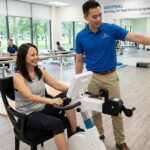
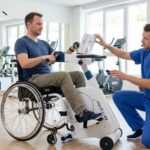
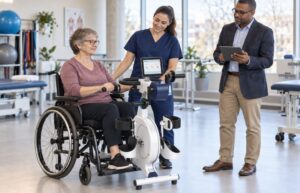
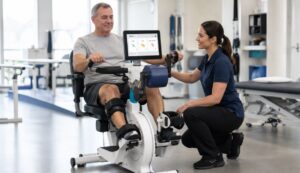
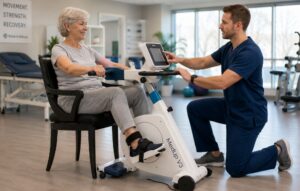
As more rehabilitation shifts beyond hospitals and clinics into the home, patients and caregivers are asking an important question: Can professional rehab equipment actually be used safely and effectively at home? For individuals recovering from stroke, surgery, neurologic conditions, or prolonged inactivity, active-passive cycle trainers are increasingly being considered as part of home-based rehabilitation programs.
Motor-assisted cycle trainers—often used in hospitals, outpatient clinics, and long-term care—are now appearing in private homes as families look for ways to continue therapy, maintain mobility, and prevent decline between formal treatment sessions. But home use requires careful consideration. This guide explains when assisted cycling makes sense at home, who it’s appropriate for, and what caregivers should understand before investing.
Did you know? The MedUp V3 Active-Passive Cycle Trainer is designed for both clinical and home-based rehabilitation, supporting arm and leg cycling for users with limited mobility.
What Is an Active-Passive Cycle Trainer?
An active-passive cycle trainer is a motor-assisted ergometer that allows users to pedal independently (active mode), receive motor assistance when effort is limited (active-assisted), or have the device move the limbs entirely (passive mode). These systems are commonly used in rehabilitation to promote movement when voluntary strength, coordination, or endurance is reduced.
Unlike traditional stationary bikes, assisted trainers adapt to the user’s ability in real time. This makes them especially valuable for individuals who cannot maintain consistent effort or who fatigue quickly.
When Home-Based Assisted Cycling Makes Sense
Home use is most appropriate when:
- A patient has completed inpatient or outpatient rehab but still needs structured movement
- Travel to therapy is difficult or limited
- A condition requires ongoing mobility maintenance
- A caregiver is available to assist with setup and supervision
- The goal is to prevent decline rather than achieve athletic conditioning
Home-based assisted cycling is commonly considered for:
- Stroke survivors
- Individuals with Parkinson’s disease or multiple sclerosis
- Post-surgical patients (hip, knee, shoulder)
- Individuals with spinal cord injury
- Seniors experiencing deconditioning
- Patients with limited endurance or balance
In these cases, the goal is not performance—but safe, repetitive movement that supports circulation, joint health, and neuromuscular engagement.
Benefits of Using Assisted Cycling at Home
Active-passive cycling at home can deliver meaningful benefits when used correctly and consistently.
Maintaining Circulation and Preventing Complications
Limited mobility increases the risk of poor circulation, swelling, and blood clots. Assisted cycling promotes rhythmic muscle movement, helping stimulate blood flow even when voluntary effort is minimal.
Preserving Joint Mobility
Without regular movement, joints can stiffen quickly. Passive and assisted cycling helps maintain range of motion and reduces the risk of contractures—particularly important after surgery or prolonged bed rest.
Reducing Muscle Tightness and Spasticity
Controlled, consistent movement can help reduce spasticity and muscle tone issues in neurologic conditions, supporting comfort and functional positioning.
Supporting Neuromuscular Activation
Repetitive cycling stimulates neural pathways involved in coordinated movement. Even when movement is assisted, this repetition plays a role in maintaining motor patterns.
Low-Impact Cardiovascular Conditioning
For individuals unable to walk or perform traditional exercise, assisted cycling provides cardiovascular engagement at a safe, controlled intensity.
Clinical research supports these benefits, including evidence that passive and assisted cycling improves blood flow, joint mobility, and neuromuscular activation in neurologic and mobility-limited populations.
Is Assisted Cycling Safe for Home Use?
Safety depends on appropriate user selection, correct setup, and clear guidance. Assisted cycling is generally considered safe when:
- The device offers controlled speed and resistance
- The user is properly positioned
- Sessions are supervised or monitored as needed
- The program is approved by a healthcare professional
For individuals with complex medical conditions, clearance from a physiotherapist, occupational therapist, or physician is strongly recommended before beginning home use.
The Role of Caregivers in Home-Based Rehab
Caregivers play a critical role in successful home use. Their responsibilities often include:
- Assisting with transfers and positioning
- Ensuring proper limb alignment
- Monitoring fatigue or discomfort
- Adjusting settings according to guidance
- Encouraging consistent participation
Well-designed systems simplify these tasks with intuitive controls and safety features, reducing caregiver strain while improving consistency.
How Home Use Compares to Clinic-Based Therapy
Home-based assisted cycling does not replace professional therapy—but it complements it.
In a clinical setting:
- Therapists adjust programs dynamically
- Manual techniques and assessments are used
- Progress is measured formally
At home:
- Movement is maintained between appointments
- Gains are preserved
- Decline is prevented
- Confidence and independence improve
Many rehab programs recommend home-based cycling as part of a long-term maintenance strategy once formal therapy sessions decrease.
What to Look for in a Home-Appropriate Cycle Trainer
Before purchasing, families and caregivers should consider:
- Active, passive, and active-assisted modes
- Upper and lower limb capability
- Adjustable speed and resistance
- Stable frame and safety features
- Ease of setup and storage
- Clear controls suitable for non-clinicians
Systems designed for both clinical and home environments provide flexibility as needs change over time.
A full overview of the physiological benefits of assisted cycling provides support for continued at-home use, beyond clinical settings.
Common Misconceptions About Home Rehab Equipment
One misconception is that rehab equipment is “only for clinics.” In reality, many modern devices are designed for broader use with appropriate guidance. Another myth is that passive movement has no value—when in fact, passive and assisted movement play a key role in circulation, joint health, and neurologic engagement.
The most important factor is appropriate use, not location.
Is an Active-Passive Cycle Trainer Worth It for Home Rehab?
For individuals who require ongoing movement support, the answer is often yes—especially when:
- Therapy access is limited
- Mobility is significantly reduced
- Long-term maintenance is required
- Caregivers want structured, safe activity options
When used consistently and under guidance, assisted cycling can help maintain function, comfort, and quality of life at home.