Choosing the right active-passive cycle trainer is an important decision for clinics, rehabilitation centers, and long-term care facilities. As demand grows for effective, low-impact rehabilitation solutions, motor-assisted cycling has become a trusted approach for improving mobility, circulation, and neurological outcomes.
However, not all active-passive cycle trainers offer the same level of performance, adaptability, or clinical value. Understanding what to look for—and how those features align with your patient population—can help ensure the equipment you select becomes a meaningful and widely used part of your therapy programs.
Did you know? MedUpBike V2’s Active-Passive Cycle Trainer is purpose-built for healthcare environments, supporting patients with neurological conditions, mobility limitations, and rehabilitation goals through customizable motor-assisted cycling programs.
What Is an Active-Passive Cycle Trainer?
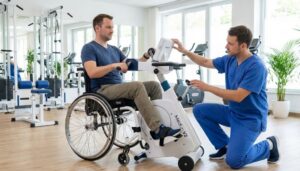
An active-passive cycle trainer is a therapeutic device that allows individuals to engage in cycling movement with or without assistance. In passive mode, the motor drives the pedals, making it possible for users with limited strength or mobility to participate. In active mode, the user contributes effort, helping build strength, endurance, and coordination.
This dual functionality makes the equipment highly versatile across a wide range of conditions, including stroke recovery, Parkinson’s disease, multiple sclerosis, post-surgical rehabilitation, and general mobility maintenance for seniors.
According to the Canadian Physical Therapy Association, repetitive and assisted movement plays an important role in promoting neuroplasticity and functional recovery.
Why Choosing the Right Equipment Matters
The quality and functionality of an active-passive cycle trainer can directly influence how often it is used and how effective it is in practice. Equipment that is difficult to operate, uncomfortable, or limited in functionality may sit unused, while well-designed systems tend to become a central part of therapy routines.
The right choice supports better patient engagement, improves safety, enhances staff efficiency, and ultimately contributes to stronger rehabilitation outcomes.
Key Features to Look For in an Active-Passive Cycle Trainer
Adjustable Resistance and Motor Assistance
A high-quality cycle trainer should provide a wide range of resistance and motor assistance levels. This allows clinicians to tailor sessions based on individual ability, from fully passive movement in early-stage rehabilitation to active resistance training as strength improves.
This adaptability is essential for supporting progression over time and ensuring the equipment remains useful across different stages of recovery.
User-Friendly Interface
Ease of use is critical in busy clinical and care environments. Staff should be able to quickly set up and adjust sessions without complexity, and patients should feel comfortable interacting with the device.
Clear displays, intuitive controls, and simple program selection can significantly improve consistency in therapy delivery and reduce the learning curve for new users.
Safety and Stability
Safety is a top priority when working with individuals who may have limited mobility, balance challenges, or cognitive impairments. A well-designed active-passive cycle trainer should include secure foot positioning, smooth and controlled motor operation, and a stable base that prevents movement during use.
These features help build confidence for both patients and caregivers, encouraging more consistent participation.
Versatility Across Patient Populations
In most facilities, patient needs vary widely. A single piece of equipment should be able to support different diagnoses, mobility levels, and therapy goals.
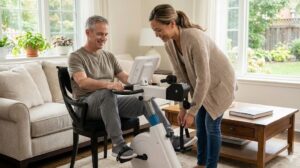
Versatile systems can often be used for both upper and lower body exercise and accommodate users in chairs, wheelchairs, or bedside settings. This flexibility increases utilization and makes the investment more valuable over time.
Data Tracking and Progress Monitoring
Modern rehabilitation increasingly relies on measurable outcomes. Equipment that tracks metrics such as session duration, speed, resistance, and user effort allows clinicians to monitor progress and adjust treatment plans accordingly.
This data can also be useful for reporting, funding justification, and demonstrating the effectiveness of therapy programs.
Matching the Equipment to Your Facility Type
Different care environments have unique requirements, and the right active-passive cycle trainer should align with those needs.
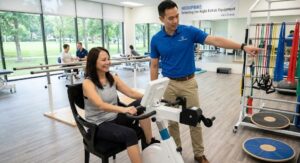
In physiotherapy clinics, flexibility and measurable outcomes are often the priority, as therapists work with a wide range of conditions and recovery goals.
In long-term care homes, ease of use and safety become especially important, with a focus on maintaining mobility, supporting circulation, and encouraging regular activity among residents.
In hospitals and rehabilitation centers, durability and performance are critical, as equipment is used frequently and must accommodate patients at varying levels of recovery.
Cost vs. Long-Term Value
While it may be tempting to prioritize upfront cost, it is more effective to evaluate long-term value. Higher-quality equipment tends to offer better durability, greater adaptability, and more consistent use over time.
When equipment becomes a regular part of therapy programs, it contributes more significantly to patient outcomes and delivers a stronger return on investment. Lower-cost options that are underutilized or require frequent replacement can end up costing more in the long run.
Common Mistakes to Avoid
One of the most common mistakes is selecting equipment based solely on price rather than functionality and fit. It is also important not to overlook ease of use for staff, as complex systems may lead to inconsistent implementation.
Another frequent issue is choosing equipment that lacks adaptability, limiting its usefulness across different patient populations. Failing to consider safety features or long-term usage needs can also reduce the overall effectiveness of the investment.
Supporting Better Outcomes Through the Right Choice
An active-passive cycle trainer is more than just a piece of equipment—it is a tool that can play a central role in rehabilitation, mobility support, and overall patient well-being. When chosen carefully, it can improve engagement, enhance therapy outcomes, and support consistent activity across a wide range of users.
By focusing on adjustability, safety, usability, and long-term value, clinics and care facilities can make informed decisions that benefit both patients and staff. To learn more about how motor-assisted cycling can be integrated into your programs, contact leading suppliers.