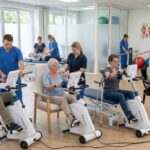
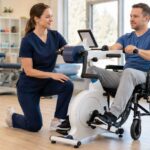
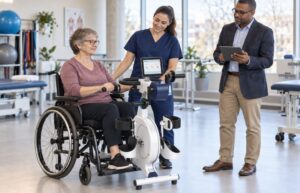
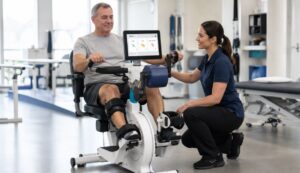
Active-passive cycling has become an increasingly valuable tool in neurological rehabilitation, helping physiotherapists support patients with conditions such as stroke, Parkinson’s disease, and multiple sclerosis. By enabling controlled, repetitive movement—whether assisted or patient-driven—this approach plays a meaningful role in improving mobility, circulation, and functional outcomes.
For physiotherapists, the appeal lies in its versatility. Active-passive cycle trainers can be introduced early in recovery, adapted across different levels of ability, and integrated into structured treatment plans. Understanding how and when to use this modality can help clinicians maximize its impact in both clinical and long-term care settings.
Did you know? MedUp Bike’s Active-Passive Cycle Trainer is designed for clinical environments, allowing physiotherapists to deliver consistent, motor-assisted cycling therapy for patients with neurological conditions and limited mobility.
What Is Active-Passive Cycling in Physiotherapy?
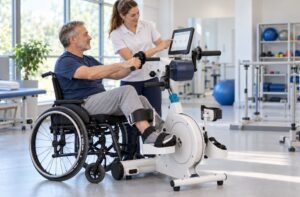
Active-passive cycling refers to a form of therapeutic exercise where a motorized system can assist or drive pedaling motion when a patient is unable to generate sufficient movement independently. As the patient progresses, they can begin to contribute effort, transitioning from passive to active participation.
This dual-function capability makes it especially effective in neurological rehabilitation, where patients may initially have limited voluntary movement but benefit from guided repetition.
According to the Canadian Physiotherapy Association, physiotherapy plays a key role in restoring movement and function, particularly through targeted, repetitive exercise interventions.
Why Repetitive Movement Matters in Neurological Rehabilitation
Neurological conditions often disrupt the communication between the brain and muscles. Repetitive, task-specific movement is widely used in physiotherapy to help retrain these pathways.
Active-passive cycling supports this by:
- Promoting consistent, rhythmic movement
- Encouraging bilateral coordination
- Stimulating sensory and motor pathways
- Supporting circulation and muscle activation
These factors contribute to neuroplasticity, the brain’s ability to reorganize and form new connections following injury or disease.
Applications in Stroke Rehabilitation
Stroke patients frequently experience weakness, reduced coordination, and limited voluntary movement. In early stages, passive cycling can help maintain joint mobility and stimulate muscle activity even when the patient cannot actively participate.
As recovery progresses, physiotherapists can gradually introduce active engagement, encouraging patients to contribute to the cycling motion.
In clinical settings, active-passive cycling is often used to:
- Support early mobilization
- Improve lower limb coordination
- Enhance cardiovascular conditioning
- Reinforce repetitive movement patterns
This progression from passive to active participation aligns well with structured rehabilitation goals.
Supporting Patients with Parkinson’s Disease
For individuals with Parkinson’s disease, maintaining movement and coordination is essential. Symptoms such as rigidity, bradykinesia (slowness of movement), and reduced motor control can significantly impact daily function.
Active-passive cycling provides a controlled environment where patients can:
- Maintain consistent movement patterns
- Improve cadence and rhythm
- Reduce stiffness
- Engage in safe, low-impact cardiovascular activity
The rhythmic nature of cycling is particularly beneficial, as it encourages smoother, more coordinated movement.
Use in Multiple Sclerosis and Other Neurological Conditions
Patients with multiple sclerosis (MS) and other neurological disorders often experience fatigue, muscle weakness, and fluctuating mobility. Active-passive cycling offers a way to engage in exercise without overexertion.
Physiotherapists may use it to:
- Maintain mobility during periods of fatigue
- Provide low-impact exercise
- Support circulation and muscle activation
- Offer adaptable intensity levels based on daily condition
This flexibility makes it a practical option for long-term management.
Integrating Active-Passive Cycling into Treatment Plans
One of the key advantages of active-passive cycling is how easily it can be incorporated into existing physiotherapy programs.
It may be used:
- As a warm-up before more targeted exercises
- As a primary intervention for lower limb movement
- As part of a circuit-based therapy session
- For independent or supervised use
Because sessions can be standardized and repeated, it also supports consistency across therapists and treatment days.
Clinical Benefits for Physiotherapy Settings
From a clinical perspective, active-passive cycling offers several advantages that extend beyond patient outcomes.
These include:
- Efficient use of therapy time
- Ability to treat multiple patients with structured programming
- Reduced physical strain on therapists
- Consistent delivery of repetitive movement
In busy clinics or long-term care environments, this can improve workflow while maintaining quality of care.
Considerations for Physiotherapists
While active-passive cycling is highly versatile, it should always be used as part of a comprehensive rehabilitation plan. Physiotherapists should consider:
- Patient condition and stage of recovery
- Ability to tolerate movement
- Proper positioning and setup
- Monitoring of fatigue and response
Individualization remains key, even when using standardized equipment.
Supporting Long-Term Outcomes in Canadian Care Settings
In Canadian healthcare environments, where physiotherapy resources and patient volumes can vary, tools that support efficient and effective rehabilitation are especially valuable.
Active-passive cycling aligns well with:
- Outpatient physiotherapy clinics
- Hospital rehabilitation units
- Long-term care facilities
Its ability to support both early-stage recovery and ongoing mobility makes it a practical addition across multiple care settings.
Advancing Rehabilitation Through Practical Tools
Active-passive cycling is more than a supportive exercise—it is a clinically relevant tool that helps physiotherapists deliver consistent, targeted movement therapy for neurological patients.
By enabling early intervention, supporting progression, and improving efficiency, it plays a meaningful role in modern rehabilitation programs. For physiotherapists looking to enhance patient outcomes while optimizing workflow, incorporating active-passive cycling can be a valuable step forward.
To learn more about how motor-assisted cycling can support your physiotherapy practice, contact the MedUp team.