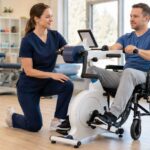
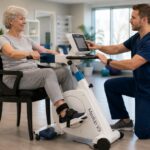
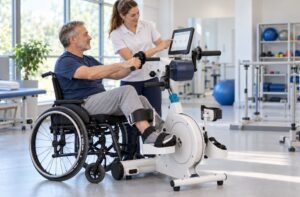
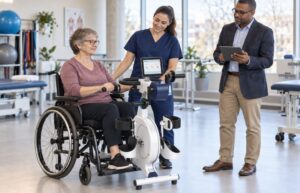
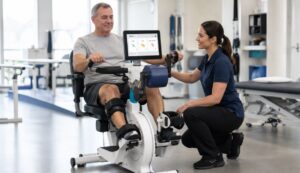
Active-passive cycling for wheelchair users can play an important role in supporting movement, circulation, mobility, and participation in rehabilitation or wellness programs. For people who use wheelchairs, traditional exercise equipment is often difficult or impossible to access safely. Many machines require transfers, standing balance, lower-body strength, or independent endurance that may not be realistic for every user.
In Canadian care settings such as physiotherapy clinics, hospitals, long-term care homes, community centres, and home-based rehabilitation programs, active-passive cycle trainers offer a more adaptable option. By allowing movement to be motor-assisted, fully passive, or user-driven, this type of equipment can help wheelchair users engage in structured activity based on their current ability.
Did you know? The MedUp V3 Active-Passive Cycle Trainer is wheelchair-accessible, licensed by Health Canada, and designed for both upper and lower limb training. It includes features such as passive, assisted, active, isokinetic, and fine motor skills training modes, as well as spasm recognition, emergency stop functionality, leg guides, hand-securing mitts, and anti-tip hooks for wheelchair users.
Why Wheelchair Users Need Accessible Exercise Options
Wheelchair users may experience reduced opportunities for regular movement, especially when equipment is not designed with accessibility in mind. Depending on the person’s condition, challenges may include limited leg movement, fatigue, spasticity, muscle weakness, reduced grip strength, poor trunk control, or difficulty transferring from a wheelchair to another seat.
This can make conventional fitness equipment impractical. Even when a facility has exercise machines available, users may not be able to access them safely or comfortably.
Accessible rehabilitation equipment helps address this gap by supporting participation without requiring every user to perform the same movement independently. This is especially important for individuals with neurological conditions, spinal cord injuries, stroke-related impairments, multiple sclerosis, Parkinson’s disease, cerebral palsy, age-related mobility loss, or post-injury limitations.
What Is Active-Passive Cycling?
Active-passive cycling uses a motor-assisted device to move the arms or legs in a cycling motion. The equipment can support different levels of participation depending on the user’s ability.
In passive mode, the device moves the limbs for the user. This can be helpful when a person has little or no voluntary movement, is in early rehabilitation, or needs gentle assisted motion.
In assisted mode, the motor helps when the user cannot complete the movement independently. This allows the person to participate while still receiving support.
In active mode, the user drives the movement independently, often with adjustable resistance to build strength and endurance.
The MedUp V3 also includes isokinetic and fine motor skills training modes, expanding its usefulness for different rehabilitation goals and stages of recovery.
How Active-Passive Cycling Supports Wheelchair Users
Active-passive cycling is not a replacement for individualized physiotherapy or medical care, but it can be a practical tool within a broader rehabilitation or wellness plan.
It may help support:
- Regular movement opportunities
- Joint mobility
- Muscle activation
- Circulation
- Coordination
- Spasticity management
- Upper and lower limb activity
- Cardiovascular engagement when appropriate
- Participation in structured routines
For wheelchair users, one of the biggest advantages is adaptability. A person may begin with passive movement and gradually contribute more effort as ability, tolerance, or confidence improves.
Upper and Lower Limb Training
Wheelchair users may benefit from both leg and arm activity, depending on their condition and goals.
Lower limb cycling may help support movement in the hips, knees, and ankles. This can be especially valuable for users who spend long periods seated and have limited opportunities for leg movement.
Upper limb cycling can support shoulder, arm, and hand engagement. For some wheelchair users, upper body strength and endurance are especially important because the arms may be used for transfers, wheelchair propulsion, or daily tasks.
The MedUp V3 is designed for both upper and lower limbs and includes leg guides, hand grips, and hand-securing mitts to support users with varying levels of control, strength, and grip ability.
Wheelchair Accessibility and Safer Positioning
For wheelchair users, equipment design matters. If a device requires a difficult transfer or unstable positioning, it may not be practical in real-world care settings.
Wheelchair-accessible active-passive cycle trainers allow users to remain seated in their own wheelchair while participating in therapy or exercise. This can reduce the physical burden on staff, caregivers, and users.
Safety-focused features are especially important. The MedUp V3 includes a stable chassis, emergency stop functionality, and anti-tip hooks designed for wheelchair users to help prevent backward tipping during higher-intensity sessions.
These details matter in Canadian clinics, care homes, and community programs where equipment must be safe, repeatable, and efficient for staff to set up.
Spasticity and Assisted Movement
Some wheelchair users experience spasticity, muscle tightness, or involuntary spasms. This can make exercise challenging, uncomfortable, or unpredictable.
Active-passive cycling equipment with spasm recognition can help improve safety during movement. The MedUp V3 includes spasm recognition software designed to quickly identify and release spasms to help protect muscles during training.
For care teams, this type of feature can provide additional confidence when supporting users with neurological conditions or physical limitations.
Practical Applications in Canadian Care Settings
Active-passive cycling can be used in several Canadian care environments.
Physiotherapy Clinics
Physiotherapy clinics may use active-passive cycling as part of neurological rehabilitation, mobility restoration, conditioning, or ongoing therapy programs. It can help clinicians provide structured movement for clients with varied abilities.
Long-Term Care Homes
In long-term care, mobility maintenance is a major concern. Active-passive cycling may help residents participate in movement programs even when independent exercise is limited. It can also support recreation, rehabilitation, and wellness initiatives.
Hospitals and Rehabilitation Centres
Hospitals and rehab centres may use active-passive cycle trainers for early mobilization, repetitive movement, and progression from passive to active participation when clinically appropriate.
Community Centres and Specialized Gyms
Accessible exercise options can help community-based programs include more people with mobility limitations. A wheelchair-accessible cycle trainer can support inclusive programming for individuals who cannot use standard gym equipment.
Home-Based Programs
For some users, home-based movement programs may be appropriate with professional guidance. MedUp positions the V3 as suitable for healthcare facilities, long-term care homes, and home-based exercise programs.
Benefits for Staff and Caregivers
Accessible rehabilitation equipment does not only benefit users. It can also support staff and caregivers by making sessions easier to set up, monitor, and repeat.
In busy care environments, equipment that is stable, intuitive, and adaptable can help reduce barriers to regular use.
Helpful features may include:
- Easy-to-adjust settings
- Touchscreen controls
- Built-in training modes
- Real-time data display
- Progress tracking
- Data export for clinical records
- Built-in wheels for transport
- Quiet operation
The MedUp V3 includes an 8-inch touchscreen, real-time training data, enhanced data export, high-performance servomotors for quiet operation, and built-in wheels for portability.
What to Consider Before Starting
Before using active-passive cycling, wheelchair users should be assessed by an appropriate healthcare professional. The right plan depends on the user’s diagnosis, mobility level, pain, spasticity, cardiovascular tolerance, skin integrity, seating position, fatigue level, and goals.
Care teams should consider:
- Proper wheelchair positioning
- Foot or hand securement
- Session duration
- Speed and resistance settings
- User comfort and fatigue
- Spasm response
- Transfer and setup requirements
- Supervision level
- Whether upper limb or lower limb training is most appropriate
The safest and most effective programs are individualized. Equipment should support the plan, not replace clinical judgment.
Choosing Wheelchair-Accessible Rehab Equipment
When selecting active-passive cycling equipment for wheelchair users, Canadian clinics and facilities should look beyond basic movement. The device should fit the needs of real users and staff workflows.
Important features include:
- Wheelchair accessibility
- Upper and lower limb training
- Passive, assisted, and active modes
- Spasm recognition
- Emergency stop access
- Stable base design
- Wheelchair anti-tip support
- Leg guides and hand supports
- Intuitive controls
- Progress tracking
- Clinical data export
- Health Canada licensing
The MedUp V3 is a Class II medical device approved by Health Canada, with licence number 103828 listed on the product page.
Supporting Inclusion Through Better Movement Options
For wheelchair users, access to movement is about more than exercise. It can support independence, confidence, participation, and quality of life. In many care settings, the challenge is not a lack of motivation—it is a lack of accessible tools.
Active-passive cycling helps close that gap by allowing users with different abilities to participate in structured movement. Whether used in a clinic, long-term care home, hospital, community centre, or home program, it provides a flexible way to support mobility-focused goals.
For Canadian care providers, investing in wheelchair-accessible rehab equipment can help create more inclusive programs while supporting staff efficiency and user engagement.