Recovering from surgery often involves a simple but important challenge:
How do you help someone begin moving again when they are not yet ready for conventional exercise?
After orthopaedic surgery, a prolonged hospital stay or another procedure that temporarily reduces mobility, patients may experience weakness, stiffness, reduced endurance and difficulty returning to normal movement.
For rehabilitation professionals, the goal is rarely to push a patient immediately into demanding exercise.
Instead, recovery often requires progressive movement—starting at the level the patient can safely tolerate and increasing participation as strength and function return.
That is where active-passive cycling can become useful.
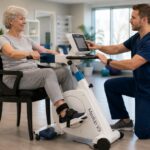
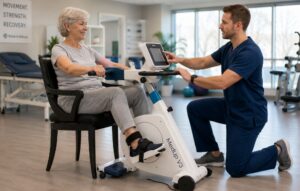
Unlike a standard exercise bike, an active-passive cycle trainer can provide fully motor-driven movement, assisted cycling or active user-powered exercise depending on the patient’s ability.
For Canadian hospitals, rehabilitation centres, physiotherapy clinics and other post-acute care settings, that flexibility can make active-passive cycling a practical addition to mobility and rehabilitation programs.
Why Mobility Can Decline After Surgery
Even when surgery is successful, recovery can temporarily reduce a person’s ability to move normally.
Depending on the procedure and the patient’s health, factors may include:
- Pain
- Swelling
- Muscle weakness
- Joint stiffness
- Reduced weight-bearing tolerance
- Fatigue
- Fear of movement
- Reduced cardiovascular endurance
- Time spent in bed or sitting
- Difficulty walking independently
The longer mobility is reduced, the more difficult it can become for some patients to return to their previous level of function.
That is why rehabilitation commonly emphasizes safe, progressive mobilization rather than prolonged inactivity.
The exact timing and type of movement depend on the surgery, medical status and instructions of the treating team.
Active-passive cycling does not replace physiotherapy or a post-operative rehabilitation plan.
Instead, it can give clinicians another way to introduce repetitive movement at a level that matches the patient’s current ability.
Where Can Active-Passive Cycling Be Used After Surgery?
Post-operative rehabilitation does not happen in only one setting.
Depending on the procedure and patient, recovery may move through several levels of care.
Hospital Rehabilitation Departments
Hospital physiotherapy and rehabilitation teams may work with patients soon after surgery, when mobility is still limited.
Some patients can stand and walk relatively quickly.
Others may require more assistance because of:
- Age
- Frailty
- Complications
- Neurological conditions
- Pre-existing mobility limitations
- Significant weakness
- Longer hospital stays
A motor-assisted cycle trainer may provide an additional option for repetitive lower-limb or upper-limb movement when clinically appropriate.
Inpatient Rehabilitation Units
Patients who need more intensive rehabilitation before returning home may transition to an inpatient rehabilitation program.
These units often work with people recovering from:
- Orthopaedic surgery
- Major illness
- Trauma
- Neurological events
- Prolonged hospitalization
A device capable of passive, assisted and active exercise can be useful because patients within the same unit may have very different abilities.
Outpatient Rehabilitation Programs
Once patients return home, many continue physiotherapy through hospital outpatient departments or community rehabilitation programs.
At this stage, therapy may focus more heavily on:
- Strength
- Endurance
- Joint mobility
- Functional movement
- Walking
- Balance
- Returning to normal activities
Active-passive cycling can allow rehabilitation professionals to adjust exercise intensity according to the patient’s progress.
Physiotherapy Clinics
Private and multidisciplinary physiotherapy clinics may also treat patients following:
- Hip replacement
- Knee replacement
- Orthopaedic surgery
- Fracture repair
- Hospital discharge
- Extended immobility
For clinics treating a mix of neurological, orthopaedic and mobility-limited patients, equipment that can serve several populations may offer greater value than a device designed around only one condition.
Complex Continuing Care and Post-Acute Care
Some patients require longer-term rehabilitation or medical support before returning to independent living.
These settings may benefit from equipment that allows patients with lower functional capacity to participate in structured movement without requiring them to use a conventional exercise bike.
Long-Term Care
Not every post-surgical patient returns immediately to a private home.
Older adults living in long-term care may undergo surgery and return to the facility needing additional mobility support.
In those situations, an active-passive trainer may fit into physiotherapy, restorative care or mobility-maintenance programming when appropriate.
What Makes Active-Passive Cycling Different From a Standard Exercise Bike?
A standard stationary bicycle assumes the user can generate enough force to turn the pedals independently.
That can be a significant limitation during early rehabilitation.
The MedUp V3 provides several training modes that allow exercise to change as the patient’s abilities change.
Passive Mode
In passive mode, the motor moves the pedals for the user.
This can be useful when a patient has little or no ability to complete the pedalling motion independently.
The objective is not to replace active rehabilitation.
Rather, passive movement can provide a way to begin repetitive lower- or upper-limb motion when the patient is not yet able to contribute sufficiently on their own.
Assisted Mode
As strength returns, a patient may be able to initiate movement but still struggle to complete the full cycling motion.
In assisted mode, the motor supplements the user’s effort.
This creates an important bridge between passive movement and fully independent cycling.
Active Mode
When the patient can pedal independently, the device can transition to active exercise.
Resistance can then be adjusted according to the user’s ability.
Isokinetic Training
For appropriate users, isokinetic mode allows the user to pedal actively while the device maintains a consistent speed and adjusts resistance.
The important point for rehabilitation facilities is that the same device can potentially remain relevant through multiple stages of recovery.
A patient does not necessarily need one machine for early-stage mobility and another once strength improves.
Supporting Progressive Rehabilitation
Post-operative recovery is rarely linear.
A patient’s ability may change from day to day.
One session may focus on gentle movement.
Another may involve more active participation.
Fatigue, pain and medical status can also affect how much exercise is appropriate at a given time.
That is why adjustable rehabilitation equipment can be particularly useful.
A therapist can select a training mode based on the patient’s current ability rather than requiring the patient to meet the demands of the equipment.
Over time, a progression might look like:
Passive movement → assisted movement → active cycling → active cycling with resistance
That progression should always be determined by the treating rehabilitation team.
Post-Surgical Uses: Where Might Cycling Fit?
Active-passive cycling may be considered in rehabilitation following several types of surgery or medical recovery.
Hip Replacement Rehabilitation
Patients recovering from hip replacement typically participate in progressive physiotherapy designed to restore mobility, strength and function.
Depending on the stage of recovery and surgeon or physiotherapist instructions, seated cycling may eventually become part of a broader exercise program.
An active-passive trainer may offer additional flexibility for patients who initially lack the strength or endurance required for conventional cycling.
Knee Replacement Rehabilitation
Knee replacement rehabilitation typically focuses on movement, strength and functional recovery.
Research on traditional continuous passive motion devices after total knee arthroplasty has not shown them to be superior to physiotherapy, which is an important distinction. A systematic review found that adding traditional CPM to physiotherapy did not significantly improve knee range of motion or patient satisfaction. The review is available through the National Library of Medicine.
Active-passive cycling is a different rehabilitation approach.
Rather than mechanically moving one knee joint through a set range, cycling can allow the patient to progress toward active participation, with assistance available when needed.
Recent evidence comparing continuous active motion with passive motion following knee replacement has suggested potential advantages for active participation in some functional outcomes, although researchers note that protocols and evidence remain variable. A 2026 systematic review discusses those findings here.
For clinical teams, the key principle remains that equipment should complement—not replace—individualized physiotherapy.
Recovery After Prolonged Hospitalization
Surgery is not the only reason a patient may leave hospital weaker than when they arrived.
A long hospital stay itself can contribute to significant deconditioning.
Patients may experience:
- Reduced muscle strength
- Lower endurance
- Difficulty standing
- Reduced walking tolerance
- General fatigue
- Loss of confidence with movement
For these patients, the ability to begin with assisted movement and gradually increase active participation may be valuable.
Orthopaedic and Lower-Limb Rehabilitation
Other procedures involving the lower limbs may also result in temporary reductions in mobility.
Whether cycling is appropriate depends on:
- Surgical precautions
- Weight-bearing status
- Joint restrictions
- Healing
- Pain
- Physician instructions
- Physiotherapy goals
Active-passive cycling should never be introduced simply because a patient has had surgery.
Clinical clearance and professional judgment are essential.
Why Wheelchair Accessibility Matters in Post-Acute Rehabilitation
Patients recovering from surgery are not always able to transfer easily onto conventional exercise equipment.
Some may temporarily use a wheelchair.
Others may already have mobility limitations that existed before surgery.
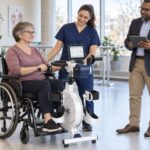
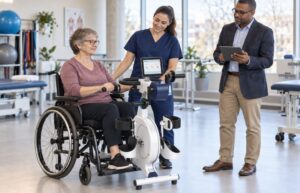
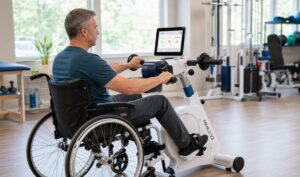
The MedUp V3 is designed to allow users to exercise from a wheelchair, which can reduce the need for unnecessary transfers during appropriate therapy sessions.
For institutional settings, this can be important.
Transfers require:
- Staff time
- Appropriate assistance
- Safe technique
- Additional equipment in some cases
- Greater physical effort from the patient
A wheelchair-accessible device can make movement-based therapy more practical for some users.
Upper-Limb Rehabilitation Matters Too
Post-operative rehabilitation is often associated with the legs, but periods of hospitalization and inactivity can affect overall strength.
The MedUp V3 supports both upper- and lower-limb training.
That expands its usefulness within institutional rehabilitation environments.
A physiotherapy or rehabilitation department may be able to use the same device with:
- Lower-limb rehabilitation patients
- Upper-limb therapy programs
- Neurological patients
- Wheelchair users
- Older adults
- People recovering from prolonged inactivity
For healthcare buyers, versatility matters because equipment has greater value when it can support multiple programs rather than a single narrowly defined patient group.
One Device, Multiple Patient Populations
This is particularly relevant for institutional purchasing.
A hospital does not typically purchase rehabilitation equipment for one individual patient.
Decision-makers need to consider:
How many different patients and programs can realistically use this equipment?
An active-passive cycle trainer may potentially serve patients involved in:
- Post-operative rehabilitation
- Stroke rehabilitation
- Neurological rehabilitation
- Mobility recovery
- Wheelchair exercise
- Geriatric rehabilitation
- Deconditioning programs
- Long-term care mobility programs
- Upper- and lower-limb therapy
MedUp positions the V3 specifically for hospitals, rehabilitation centres, long-term care homes and other healthcare facilities, as well as home-based programs.
That multi-use potential can be an important consideration when evaluating capital equipment.
What Should Hospitals and Rehab Facilities Look for?
Healthcare organizations purchasing rehabilitation equipment need to consider much more than whether a device can make pedals turn.
Important questions include:
Can It Accommodate Different Functional Levels?
Look for equipment that can support users who require:
- Fully passive movement
- Motor assistance
- Independent active movement
- Resistance-based exercise
Is It Wheelchair Accessible?
Accessibility can greatly expand the number of patients who can use the equipment.
Does It Support Upper and Lower Limbs?
Multi-purpose equipment may provide stronger utilization across a department.
Can Staff Move It Between Treatment Areas?
The MedUp V3 includes built-in wheels to allow it to be transported within a facility.
Are There Appropriate Safety Features?
The MedUp V3 includes spasm-recognition technology designed to detect and respond when spasticity occurs, along with emergency-stop and stabilization features.
Can Clinicians Track Progress?
Clinical feedback can help therapists monitor sessions and evaluate changes over time.
The V3 includes training feedback and enhanced data export capabilities for clinical tracking.
Is the Equipment Licensed for the Canadian Market?
For Canadian hospitals, rehabilitation facilities and clinics, regulatory status matters.
The MedUp V3 is a Health Canada licensed Class II medical device, licence number 103828.
Who Typically Makes the Purchase Decision?
Depending on the organization, active-passive rehabilitation equipment may be evaluated or purchased by:
- Physiotherapy departments
- Rehabilitation medicine programs
- Occupational or physical rehabilitation teams
- Hospital procurement departments
- Clinical engineering or equipment committees
- Directors of rehabilitation
- Long-term care administrators
- Clinic owners
- Physiotherapy practice owners
- Capital equipment committees
- Accessibility or mobility-program managers
The clinical team typically determines whether the equipment fits patient needs, while purchasing or procurement departments may evaluate factors such as cost, regulatory status, durability, service and expected utilization.
Rehabilitation Equipment Should Support Clinicians—Not Replace Them
No piece of equipment determines a rehabilitation program.
A patient’s surgeon, physician, physiotherapist and broader healthcare team remain responsible for determining:
- When movement should begin
- Which movements are safe
- Appropriate range
- Weight-bearing precautions
- Intensity
- Duration
- Frequency
- Progression
Active-passive cycling should be viewed as a tool within a broader rehabilitation program.
Its value lies in giving clinicians another way to provide controlled, repetitive movement at different levels of patient ability.
Active-Passive Cycling Equipment for Canadian Hospitals and Rehabilitation Facilities
Post-surgical rehabilitation requires flexibility.
Some patients can exercise actively soon after surgery.
Others need considerable assistance before independent movement becomes possible.
A rehabilitation device that can move with the patient—from passive movement to assisted exercise and eventually active training—can provide useful flexibility across the recovery process.
The MedUp V3 Active-Passive Cycle Trainer is designed for healthcare facilities working with patients who have mobility limitations, including hospitals, rehabilitation centres, physiotherapy clinics and long-term care homes.
It provides:
- Passive, assisted and active training
- Upper- and lower-limb exercise
- Wheelchair accessibility
- Multiple resistance and training modes
- Spasm-recognition technology
- Patient training feedback
- Clinical data export
- Portable design
- Health Canada Class II licensing
For organizations evaluating post-surgical or mobility rehabilitation equipment, the key question is not whether every patient should use active-passive cycling.
The better question is whether having a flexible movement therapy tool could help clinicians support more patients at more stages of rehabilitation.
Contact MedUp Bike to discuss the MedUp V3, Canadian pricing, shipping and suitability for your rehabilitation program.
SEO Details
SEO Title: Active-Passive Cycling After Surgery | Rehab Equipment Canada
Meta Description: Learn how active-passive cycling may support post-surgical rehabilitation in hospitals, rehab centres and physiotherapy clinics across Canada.
Suggested URL Slug: active-passive-cycling-after-surgery-rehabilitation
Primary Search Theme: