Purchasing rehabilitation equipment is rarely a clinical decision alone. Healthcare facilities must also consider budgets, staff capacity, patient demand, equipment utilization and whether a new device can support measurable program goals.
For clinics, hospitals, rehabilitation centres and long-term care homes serving people with limited mobility, the MedUp V3 Active-Passive Cycle Trainer offers more than a single form of exercise. Its passive, assisted and active training modes allow one device to support different users and stages of rehabilitation. The business case, however, should be based on how well those capabilities match the facility’s actual needs.
Start With the Patient and Program Need
The first question is not whether active-passive cycling offers useful features. It is whether a facility regularly serves people who cannot use conventional exercise equipment safely or effectively.
Potential users may include people experiencing:
- Stroke-related weakness or hemiparesis
- Parkinson’s disease or multiple sclerosis
- Spinal cord or acquired brain injuries
- Spasticity, stiffness or limited voluntary movement
- Reduced mobility associated with aging
- Deconditioning after hospitalization or surgery
- Difficulty transferring onto conventional exercise equipment
- Limited strength or endurance
- A need for upper- or lower-limb rehabilitation
A facility that regularly works with several of these populations may have a stronger case for investing than one that would use the equipment for only a small number of occasional patients.
The goal is to identify a real service gap. If patients are unable to participate fully in existing movement programs, an active-passive cycle trainer may make therapeutic exercise accessible to more people.
Estimate How Often the Equipment Will Be Used
Equipment value depends heavily on utilization. A capable device that remains unused for much of the week provides limited value, regardless of its features.
Before requesting approval, estimate:
- How many current patients or residents could use the equipment
- How many sessions could be scheduled each week
- Whether it would support individual and supervised group programming
- Which departments or programs could share it
- Whether demand is expected to increase
- How long a typical session and changeover would take
- Whether the device could be used for both upper- and lower-limb exercise
A useful internal calculation is:
Estimated annual sessions = anticipated weekly sessions × operating weeks per year
Facilities can then divide the total acquisition and implementation cost by the estimated number of sessions over the equipment’s expected useful life. This does not capture every clinical or operational benefit, but it provides a more meaningful measure than purchase price alone.
For example, equipment used in several programs every week may deliver substantially more value per session than a lower-priced device serving only one narrow purpose.
Consider How Many Patient Populations One Device Can Support
Versatility strengthens the business case because it broadens potential utilization.
The MedUp V3 provides five training modes:
- Passive mode for users who cannot produce voluntary movement
- Assisted mode when the user can contribute but cannot complete the movement independently
- Active mode for user-driven cycling with adjustable resistance
- Isokinetic mode that maintains a consistent speed while resistance changes
- Fine motor skills mode for exercises involving smaller muscle groups and greater precision
It can also be used for upper- and lower-limb training and is accessible to wheelchair users. This allows the equipment to remain relevant as users’ abilities and rehabilitation goals change.
Instead of purchasing separate devices for different levels of participation, a facility may be able to use one adaptable system across neurological rehabilitation, post-hospital recovery, mobility-maintenance and supportive exercise programs.
Evaluate the Effect on Staff Workflow
Clinical potential alone does not guarantee successful implementation. Equipment must fit the way staff actually work.
A business case should address:
- Where the device will be located
- Which staff members will use it
- How users will be assessed and positioned
- How quickly settings can be changed between sessions
- Whether staff orientation will be required
- How the device will be cleaned between users
- Whether it must move between rooms or departments
- How sessions and outcomes will be documented
The MedUp V3 includes built-in wheels for movement within a facility, an intuitive touchscreen and a favourites function that allows preferred training settings to be saved. Its real-time feedback and data-export capabilities can also support progress monitoring and repeatable programming.
These features may make implementation easier, but each facility should still establish its own protocols based on patient needs, staffing and professional oversight.
Identify the Value of Wheelchair Accessibility
Wheelchair accessibility should be treated as an operational and service-delivery consideration—not simply an additional feature.
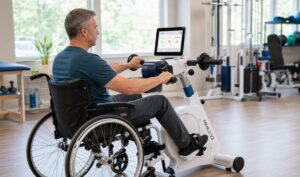
Traditional exercise equipment may require a user to transfer onto a seat, maintain balance or generate enough independent movement to begin exercising. These requirements can exclude people with substantial mobility limitations or create additional demands on staff.
A wheelchair-accessible trainer can reduce these participation barriers by allowing appropriate users to exercise from their own wheelchair. This may:
- Expand access to movement-based programming
- Reduce the need for unnecessary equipment transfers
- Help staff accommodate a broader range of mobility levels
- Make scheduled rehabilitation or wellness sessions more practical
- Increase the number of residents or patients who can use the equipment
Facilities serving wheelchair users should assess room dimensions, positioning, anti-tip requirements and staff procedures as part of the implementation plan.
Include Measurable Clinical and Program Indicators
A strong business case identifies how success will be evaluated after purchase.
Measurements will vary by facility and should be determined by qualified healthcare professionals. Depending on the program, useful indicators may include:
- Number of sessions delivered
- Number of patients or residents using the equipment
- Participation and completion rates
- Progression from passive to assisted or active movement
- Session duration, speed or resistance
- Left-right symmetry and user contribution
- Patient tolerance and engagement
- Staff time required for setup and supervision
- Number of departments or programs using the device
- Clinician and user feedback
The purpose is not to guarantee a particular clinical outcome. It is to determine whether the equipment is being used as intended and contributing meaningfully to the facility’s rehabilitation or mobility programming.
Look Beyond the Initial Purchase Price
The lowest-priced device is not necessarily the least expensive over time. Total value depends on what is included, how frequently the equipment is used and whether it remains suitable as patient needs change.
Decision-makers should consider:
- Included accessories
- Delivery and installation
- Staff orientation
- Warranty coverage
- Service and technical support
- Availability of replacement parts
- Expected durability
- Regulatory status
- Potential tax treatment
- Anticipated useful life
- Compatibility with existing programs and spaces
MedUp has published a separate guide explaining active-passive cycle trainer costs and value considerations in Canada. A formal quotation should clarify the complete delivered cost and what support is included.
Confirm Canadian Medical Device Licensing
Regulatory status should form part of the procurement review, particularly when equipment will be used by people with complex medical or mobility needs.
Health Canada explains that Class II, III and IV medical devices require a valid medical device licence before they can be sold or imported in Canada. Licensed devices can be checked through the government’s Medical Devices Active Licence Listing.
The MedUp V3 is a Health Canada licensed Class II medical device under licence number 103828. Facilities can learn more about the role of licensing in MedUp’s guide to Health Canada licensed rehabilitation equipment.
Licensing does not replace a facility’s clinical assessment, procurement process or safe-use protocols. It does, however, help decision-makers distinguish regulated rehabilitation equipment from general consumer fitness products.
Build the Proposal Around Five Questions
A concise internal proposal should answer five questions:
- Who will use it?
Identify patient groups, mobility levels and relevant programs. - How often will it be used?
Estimate weekly and annual sessions using realistic scheduling assumptions. - What problem will it solve?
Describe the limitations of existing equipment or gaps in accessible programming. - How will it fit into daily operations?
Address staffing, space, positioning, cleaning, documentation and training. - How will success be measured?
Establish clinical, utilization and operational indicators before implementation.
This structure gives administrators and procurement teams a clearer basis for evaluating the request than a list of product features alone.
When Does an Active-Passive Cycle Trainer Make Business Sense?
The investment may be easier to justify when a facility:
- Regularly serves people with neurological or significant mobility limitations
- Needs wheelchair-accessible rehabilitation equipment
- Can use the device across multiple programs or departments
- Requires both upper- and lower-limb training
- Works with users at different stages of mobility or recovery
- Has identified staff responsible for implementation
- Can realistically schedule consistent weekly use
- Has a plan for monitoring utilization and outcomes
Conversely, the business case may be weaker if the eligible population is very small, no staff member will take ownership of implementation or the device cannot be incorporated into regular programming.
Turn Rehabilitation Equipment Into a Working Program
An active-passive cycle trainer delivers its greatest value when it becomes part of a defined rehabilitation or mobility program—not when it is treated as a stand-alone equipment purchase.
The MedUp V3 combines passive, assisted and active exercise; upper- and lower-limb training; wheelchair accessibility; spasm recognition; symmetry feedback; and clinical data export in one system. For the right facility, this versatility can support broader access, progressive programming and sustained utilization.
The final decision should be based on patient need, expected usage, staff readiness and long-term program fit. When those elements align, an active-passive cycle trainer can become a practical resource serving multiple users, clinicians and care objectives.
Contact MedUp Bike to discuss facility requirements, Canadian pricing, shipping and whether the MedUp V3 is appropriate for your rehabilitation or mobility program.