Cycling can play several different roles in rehabilitation. One person may need a motor to move their arms or legs completely. Another may be able to initiate the movement but require help completing each rotation. Someone further along may pedal independently and benefit from added resistance.
These are not simply different exercise intensities. Passive, assisted and active cycling involve different levels of user participation and may serve different purposes within a rehabilitation or mobility program.
The MedUp V3 Active-Passive Cycle Trainer can move automatically between passive, assisted and active cycling according to the user’s ability to move their arms or legs. It also provides isokinetic and fine-motor-skills training modes, allowing clinicians to select and adapt training for different users, goals and stages of rehabilitation.
What Is the Difference Between Active, Passive and Assisted Cycling?
The primary difference is who—or what—provides the force required to turn the pedals.
- Passive cycling: The motor moves the user’s arms or legs without requiring voluntary effort.
- Assisted cycling: The user contributes to the movement, while the motor provides help when needed.
- Active cycling: The user turns the pedals independently, with resistance added when appropriate.
- Isokinetic cycling: The user provides the effort while the equipment maintains a consistent cycling speed by varying resistance.
- Fine-motor-skills training: Specialized exercises focus on smaller muscle groups, coordination and more precise movement.
No single mode is inherently best. The appropriate mode depends on the user’s movement, strength, coordination, endurance, medical status and rehabilitation objectives.
| Training mode | Who creates the movement? | When it may be considered | General purpose |
|---|---|---|---|
| Passive | The motor | Voluntary movement is absent or very limited | Provide supported, repetitive movement |
| Assisted | The user and motor | The user can contribute but cannot maintain the full cycle | Encourage participation with support |
| Active | The user | Independent cycling is possible | Develop strength and endurance |
| Isokinetic | The user, with adaptive resistance | Controlled active exercise is appropriate | Maintain a selected speed as effort changes |
| Fine motor | The user, with specialized settings | More precise movement and coordination are being addressed | Train smaller muscle groups and motor control |
What Is Passive Cycling?
During passive cycling, the equipment’s motor moves the pedals and guides the user’s arms or legs through the cycling motion. The user does not need to generate the force required to complete each rotation.
Passive cycling may be considered when a person:
- Has little or no voluntary limb movement
- Is beginning rehabilitation after a significant loss of mobility
- Experiences substantial weakness or fatigue
- Cannot maintain a continuous cycling motion
- Has neurological or neuromuscular limitations
- Requires gentle, repetitive movement under appropriate supervision
Because the motor produces the movement, passive cycling can make movement accessible to someone who cannot use a conventional exercise bike.
Passive does not mean that positioning or supervision is unimportant. The user still needs to be positioned appropriately, with suitable speed, range, duration and limb support. Comfort, joint restrictions, muscle tone, skin integrity, cardiovascular tolerance and other clinical factors must also be considered.
What Are the Potential Purposes of Passive Cycling?
Depending on the person and their care plan, passive cycling may be used to support:
- Regular movement of the arms or legs
- Joint mobility
- Circulation
- Muscle and tissue movement
- Management of stiffness
- Familiarity with a repetitive movement pattern
- Preparation for more active participation
- Access to movement when independent exercise is not possible
A review of passive cycling following spinal cord injury found that it may affect several musculoskeletal and cardiovascular measures, while also emphasizing that study methods and results vary. This is why passive cycling should be applied according to the individual’s condition rather than presented as a guaranteed treatment outcome. Readers interested in the research can review the published systematic review in the National Library of Medicine.
Passive cycling should not be confused with active exercise. If the motor is doing all the work, the user is not producing the same muscular effort that would occur during independently powered cycling. Its purpose and expectations are therefore different.
What Is Assisted Cycling?
Assisted cycling bridges the gap between completely motor-driven movement and independent cycling.
In assisted mode, the user contributes as much effort as possible. When that effort is insufficient to complete or maintain the cycling motion, the motor provides additional support.
This may be appropriate when the user:
- Can initiate movement but cannot complete a full rotation
- Has some muscle activation but limited strength
- Can pedal temporarily but fatigues quickly
- Has uneven ability between the left and right sides
- Is progressing from passive toward active exercise
- Experiences changes in ability from one session or day to another
The defining feature is participation. The user is contributing, but the equipment prevents the session from stopping every time their effort declines.
Why Is Assisted Cycling Important in Rehabilitation?
Without assistance, someone with limited strength or motor control may be unable to complete enough continuous rotations to participate meaningfully. The pedals may stop at the most difficult part of the movement, even though the user can contribute during other portions.
Motor assistance can help complete the motion while still allowing the person to participate at their present ability.
Assisted cycling may help rehabilitation professionals:
- Encourage voluntary effort
- Provide support without requiring complete motor control
- Extend activity when fatigue begins
- Create a transition between passive and active movement
- Adjust training as the user’s abilities change
- Accommodate users whose performance varies between sessions
Assistance should not be treated as a shortcut or failure. For some users, it is the feature that makes meaningful participation possible.
What Is Active Cycling?
During active cycling, the user generates the force required to turn the pedals independently. The motor is not moving the limbs for them.
Resistance can be adjusted to suit the person’s strength, endurance and training goals. Active cycling may therefore range from relatively light, continuous movement to more demanding exercise when clinically appropriate.
It may be considered when the user:
- Can complete the cycling motion independently
- Has sufficient control to maintain a safe movement pattern
- Is ready to build strength or endurance
- Can tolerate greater cardiovascular or muscular effort
- Is working toward more independent exercise
- Requires adjustable resistance as ability improves
Active cycling is the closest of the three primary modes to conventional exercise. The important difference is that an active-passive trainer can still provide additional support if the user’s ability changes.
Is Active Cycling Always the Goal?
Not necessarily.
For some people, progression toward active cycling may be an important rehabilitation objective. Someone recovering from surgery, illness or a neurological event may move from passive cycling to assisted participation and eventually to independent pedalling.
For people with progressive or long-term conditions, however, maintaining movement, comfort, participation or current ability may be more realistic than progressing through every mode.
A user may also require different modes at different times. Someone might cycle actively at the beginning of a session but require assistance as fatigue develops. Another user may have strong days and weak days, or greater control in the arms than the legs.
The appropriate objective should be determined by the user and their healthcare team—not by an assumption that every person must eventually reach the same mode.
What Is Isokinetic Cycling?
Isokinetic cycling is user-driven, but the equipment controls the cycling speed.
As the user applies more force, resistance changes to keep the movement at a consistent speed. This differs from a standard active mode, where resistance may remain at a selected level while cycling speed changes according to the user’s effort.
Isokinetic training may be useful when a rehabilitation professional wants:
- A controlled cycling speed
- Resistance that responds to the user’s effort
- Consistent movement during active training
- A structured way to challenge strength or muscular control
- Greater control over the training conditions
The user must still generate the movement, making isokinetic cycling a form of active rather than passive exercise.
What Is Fine-Motor-Skills Training?
Fine-motor-skills training focuses on smaller, more precise movements rather than the larger continuous movements normally associated with arm or leg cycling.
The MedUp V3 includes a specialized fine-motor-skills mode intended for exercises involving smaller muscle groups, control and precision. This may be particularly relevant later in neurological rehabilitation when the goal extends beyond producing movement to improving its quality.
Fine-motor training does not replace occupational therapy or an individualized rehabilitation program. It gives clinicians another training option that may be incorporated when appropriate.
How Can Users Progress Between Cycling Modes?
Progression is rarely as simple as completing a predetermined number of passive sessions and then moving permanently into active exercise.
A clinician may consider several factors:
- Ability to initiate the movement
- Ability to complete a full rotation
- Amount of motor assistance required
- Left-right contribution and symmetry
- Muscle control
- Resistance tolerance
- Speed and coordination
- Fatigue during and after training
- Pain or discomfort
- Spasms or changes in muscle tone
- Ability to maintain suitable positioning
- The user’s functional and rehabilitation goals
A possible progression might look like this:
- Passive cycling provides motor-driven movement when the user cannot pedal independently.
- Assisted cycling begins when the user can contribute some effort.
- Active cycling becomes possible when the user can maintain the movement without motor assistance.
- Resistance or isokinetic training may be introduced when additional active challenge is appropriate.
- Fine-motor-skills training may support more precise movement and coordination goals.
This is only an example—not a universal clinical protocol. Some users may begin in active mode, alternate among modes or remain in passive or assisted cycling over the long term.
Why Automatic Transition Between Modes Matters
A user’s effort does not always remain constant throughout a session.
Strength, coordination and endurance may change from one rotation to the next. If equipment operates in only one mode, the user may either receive more assistance than needed or be unable to continue when their effort declines.
The MedUp V3 can transition automatically and quietly between passive, assisted and active operation according to how well the user is moving. This allows the equipment to respond to changing participation without requiring the session to stop repeatedly for manual adjustments.
For clinicians and caregivers, this adaptability may make it easier to:
- Encourage the user to contribute whenever possible
- Provide assistance only when it is needed
- Accommodate fatigue during a session
- Work with users who have fluctuating abilities
- Support different users with one piece of equipment
How Do Upper- and Lower-Limb Applications Differ?
Active, assisted and passive cycling can be used for the arms or legs, but the positioning and objectives are not identical.
Lower-limb cycling
Lower-limb training involves movement at the hips, knees and ankles. Depending on the user, it may form part of a program addressing mobility, conditioning, stiffness, strength, coordination or lower-limb participation.
Foot supports and leg guides may be required when the user has weakness, poor control or difficulty maintaining alignment.
Upper-limb cycling
Upper-limb cycling involves the shoulders, elbows, arms and hands. It may be used when lower-limb cycling is inappropriate or when upper-body movement, strength, endurance or coordination is a priority.
Some users may require adapted handles or hand-securing supports if grip is limited. The height and distance of the arm cranks must also be adjusted so the user is not reaching excessively or placing the shoulders in an unsuitable position.
Because the MedUp V3 includes separate upper- and lower-limb cycling systems, users do not have to transfer a single pedal unit between arm and leg exercises.
Can Wheelchair Users Perform Each Type of Cycling?
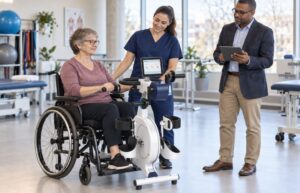
Depending on their abilities and professional assessment, wheelchair users may participate in passive, assisted or active cycling while remaining seated in their own wheelchair.
The equipment and wheelchair must be positioned securely. Considerations may include:
- Wheelchair brakes
- Anti-tip support
- Distance from the pedals
- Seat height and posture
- Foot, leg or hand securement
- Trunk stability
- Joint alignment
- Access to the emergency stop
- Staff or caregiver supervision
MedUp’s guide to active-passive cycling for wheelchair users explains these applications and equipment considerations in greater detail.
How Should a Rehabilitation Facility Choose Among the Modes?
The decision should begin with the user—not the equipment.
Clinicians and care teams should ask:
- Can the user initiate the cycling movement?
- Can they complete and repeat the full motion?
- How much assistance is required?
- Does their performance change as they fatigue?
- Are the arms, legs or both being addressed?
- What are the immediate and longer-term objectives?
- Are positioning, securement or spasm-management features required?
- How will participation and progress be monitored?
Facilities evaluating the broader operational and financial considerations can also review how to build the business case for an active-passive cycle trainer.
Frequently Asked Questions
Is passive cycling considered exercise?
Passive cycling creates movement, but the motor rather than the user supplies the force. It does not place the same muscular demand on the user as active cycling. Its purpose may involve supported movement, joint mobility, circulation or preparation for greater participation, depending on the individual.
What is the difference between assisted and passive cycling?
In passive cycling, the motor produces the movement. In assisted cycling, the user contributes effort and the motor supplies only the additional help needed to continue or complete the cycling motion.
Can someone switch modes during the same session?
Yes. A user’s participation may change as muscles loosen, confidence increases or fatigue develops. The MedUp V3 can transition between passive, assisted and active operation according to the user’s effort.
Is active cycling better than passive cycling?
It depends on the person and the objective. Active cycling requires voluntary effort and may be appropriate for strength or endurance training. Passive cycling makes repetitive movement accessible when active pedalling is not possible. One is not a substitute for the other.
Can active-passive cycling replace physiotherapy?
No. A cycle trainer is a rehabilitation or exercise tool, not a replacement for assessment, hands-on treatment or an individualized plan developed by qualified healthcare professionals.
How does a clinician know which mode to use?
The choice may depend on voluntary movement, strength, coordination, endurance, fatigue, positioning, medical precautions and rehabilitation goals. A qualified healthcare professional should determine the appropriate starting mode and progression.
One Device, Different Levels of Participation
The practical value of active-passive cycling lies in its ability to meet users at their current level.
Passive cycling enables movement when independent pedalling is not possible. Assisted cycling allows the user to participate while receiving the support needed to maintain the motion. Active and isokinetic modes introduce progressively greater user effort, while fine-motor-skills training supports more precise movement objectives.
The MedUp V3 brings these five modes together with upper- and lower-limb training, wheelchair accessibility, spasm recognition, symmetry feedback and clinical data tracking.
For healthcare facilities, rehabilitation professionals, patients and caregivers, the central question is not which mode is universally best. It is which mode safely and appropriately supports the individual’s abilities and goals today—and how the equipment can continue adapting as those needs change.
Contact MedUp Bike to discuss the MedUp V3, Canadian pricing, shipping and suitability for your rehabilitation, care or home-based movement program.