Upper- vs. Lower-Limb Cycling in Rehabilitation: When Is Each Used?
Cycling-based rehabilitation is not limited to the legs. Depending on a person’s abilities and therapeutic objectives, cycling movements can involve the arms, legs or both at different points in a rehabilitation program.
The MedUp V3 Active-Passive Cycle Trainer includes separate systems for upper- and lower-limb exercise. This allows clinicians and caregivers to select the appropriate application without moving one pedal unit between positions—and to use passive, assisted or active training according to the user’s abilities.
Understanding the differences between arm and leg cycling helps facilities, clinicians and families make better use of equipment and establish more appropriate training goals.
What Is Lower-Limb Cycling in Rehabilitation?
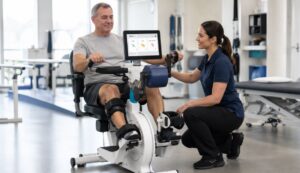
Lower-limb cycling involves repeated movement at the hips, knees and ankles. The user’s feet are positioned in the pedals while the legs follow a circular movement pattern.
Depending on the individual, lower-limb cycling may form part of a program addressing:
- Lower-limb movement and participation
- Strength and endurance
- Joint mobility
- Stiffness associated with inactivity
- Coordination
- General conditioning
- Progressive return to active exercise
- Ongoing mobility or wellness programming
Lower-limb cycling may be passive, assisted or active. In passive mode, the motor moves the user’s legs when the person cannot generate or sustain the movement independently. Assisted training allows the user to contribute while receiving motor support. Active cycling requires the user to turn the pedals, with resistance adjusted to suit the program.
The appropriate choice is not simply “arms or legs.” It depends on the user’s abilities, positioning, rehabilitation priorities and capacity to participate safely.
What Is Upper-Limb Cycling?
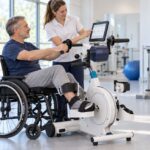
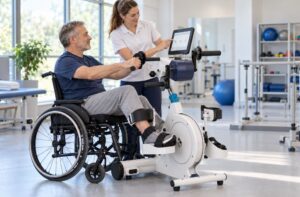
Upper-limb cycling—sometimes called arm cycling or arm-crank exercise—uses a circular movement of the shoulders, elbows, arms and hands.
It may be considered when:
- Upper-limb movement is a rehabilitation priority
- Lower-limb exercise is temporarily inappropriate
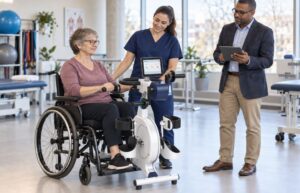
- A person primarily uses a wheelchair
- Upper-body strength or endurance is being addressed
- General conditioning is needed without relying on the legs
- Coordination and active participation are program goals
- The user needs an alternative form of rhythmic exercise
An upper-limb cycling system should be adjusted so the user can maintain an appropriate posture without excessively reaching upward or forward. The shoulders should remain comfortable, and the elbows should generally retain some bend during the movement.
Users with limited grip may also need therapeutic handles or hand-securing supports. The MedUp V3 includes standard and therapeutic handle options, as well as securing mitts for users who cannot reliably maintain their grip.
How Do Upper- and Lower-Limb Applications Compare?
| Consideration | Upper-limb cycling | Lower-limb cycling |
|---|---|---|
| Primary joints involved | Shoulders and elbows | Hips, knees and ankles |
| Main contact point | Hands or forearms | Feet |
| Typical positioning focus | Crank height, reach and shoulder comfort | Seat distance, leg alignment and foot security |
| Potential supports | Therapeutic handles or securing mitts | Foot supports and leg guides |
| Common program focus | Arm movement, coordination and upper-body conditioning | Leg movement, mobility, conditioning and lower-limb participation |
| Wheelchair application | Can provide exercise without relying on the legs | Can allow supported leg cycling from a wheelchair |
| Training modes | Passive, assisted or active | Passive, assisted or active |
These are general distinctions. A qualified healthcare professional should determine the appropriate application and settings for each user.
Why Positioning Matters for Both Applications
Correct positioning affects comfort, alignment and the quality of the cycling movement.
For lower-limb cycling, the chair or wheelchair must be positioned at an appropriate distance from the pedals. The knees should not remain excessively bent or become fully locked during the cycle. Foot supports and leg guides may help users who have weakness, poor control or difficulty maintaining alignment.
For upper-limb cycling, crank height and reach are particularly important. A user should not have to elevate the shoulders or lean substantially forward to complete the movement. Handles must also suit the person’s hand function and grip.
Published rehabilitation research identifies factors such as seat position, foot placement, cadence, crank dimensions and workload as relevant biomechanical considerations when cycling is used therapeutically.
The MedUp V3’s stable chassis, adjustable components, leg guides and handle options are designed to support positioning for both applications.
Can the Same Training Modes Be Used for Arms and Legs?
Passive, assisted and active modes can be used for either the upper or lower limbs, but the reason for selecting a mode may differ from one user to another.
A person may use passive leg cycling because voluntary lower-limb movement is limited while completing active arm cycling during a different session. Another user may require assisted arm cycling because of upper-limb weakness but perform active leg cycling with resistance.
The appropriate mode is therefore based on the abilities of the limbs being trained—not necessarily the person’s overall mobility level.
MedUp’s guide to active, passive and assisted cycling explains how these training modes differ and how users may progress between them.
When Might a Program Use Both?
Upper- and lower-limb cycling do not need to compete for a place in a rehabilitation or mobility program. They can serve complementary purposes.
A clinician might select different applications on different days, alternate them according to fatigue or focus on the area most relevant to the person’s current goals. Facilities can also use the same equipment with multiple users who have very different needs.
Having both capabilities in one system may be particularly valuable in:
- Physiotherapy and rehabilitation clinics
- Hospitals
- Long-term care homes
- Community rehabilitation programs
- Specialized exercise facilities
- Home-based rehabilitation settings
For wheelchair users, access to both options can broaden participation without requiring a transfer onto conventional exercise equipment. MedUp’s practical guide to active-passive cycling for wheelchair users provides additional positioning and implementation considerations.
What Should Facilities Consider?
Before selecting upper- or lower-limb cycling, rehabilitation teams should consider:
- Which limbs are the current priority?
- Can the user initiate or sustain the movement?
- Is passive or motor-assisted movement required?
- Can the user maintain an appropriate seated position?
- Are leg guides, foot supports or adapted handles needed?
- Can the equipment be adjusted without excessive reaching?
- How will participation and progress be monitored?
- Could other users or programs benefit from the alternative application?
The MedUp V3 provides separate upper- and lower-limb cycling systems, five training modes, wheelchair-accessible positioning, spasm recognition, symmetry feedback and clinical data export. This allows the equipment to support different users without being limited to a single limb group or stage of rehabilitation.
Choosing the Right Application
Lower-limb cycling may be selected when leg movement, mobility, conditioning or lower-limb participation is the priority. Upper-limb cycling may be more appropriate when the arms require attention, when exercise should not rely on the legs or when upper-body conditioning is needed.
For many healthcare facilities, the greatest value comes from having access to both. An adaptable active-passive cycle trainer can support different rehabilitation priorities, levels of voluntary movement and patient populations within one system.
Contact MedUp Bike to discuss upper- and lower-limb training requirements and whether the MedUp V3 is appropriate for your facility or home-based program.